
Human Services
How “Cheap” Insurance Policies Secretly Jeopardize Your Human Services Mission
Julian Vargas ·
For human services organizations, the most severe threat to operational survival rarely stems from a sudden regulatory shift or a public funding contraction. Instead, it is frequently hidden inside a highly restrictive endorsement buried deep within a commodity-priced commercial insurance policy.
Every year, CFOs, HR Directors, and operational leaders of non-profits, community clinics, and behavioral health networks are pressured to select the lowest upfront insurance premiums to preserve tight budgets. Tasked with managing the renewal off the side of their desks, these “Delegated Owners” operate under the false premise that a lower rate simply represents a shrewder purchase.
The structural reality of commercial risk placement is far more punishing: heavily discounted premiums are almost always engineered by stripping away essential coverage.
When a severe claim occurs, whether a complex allegation of abuse or a catastrophic passenger transport accident, the carrier formalizes a swift coverage denial. This leaves the organization to absorb six-figure legal fees and settlements entirely out of operating capital. For the financial leader who recommended the policy, this represents not just a budgetary crisis, but a profound professional vulnerability.
To safeguard your organization’s mission and protect your own professional reputation, you must stop treating insurance as a “Blind-Buy” and master the only metric that matters: The Total Cost of Risk (TCOR).
The TCOR Reality vs. The Upfront Premium
When every dollar allocated to administrative overhead is a dollar diverted from direct client programming, the temptation to view commercial insurance as a transactional commodity is high.
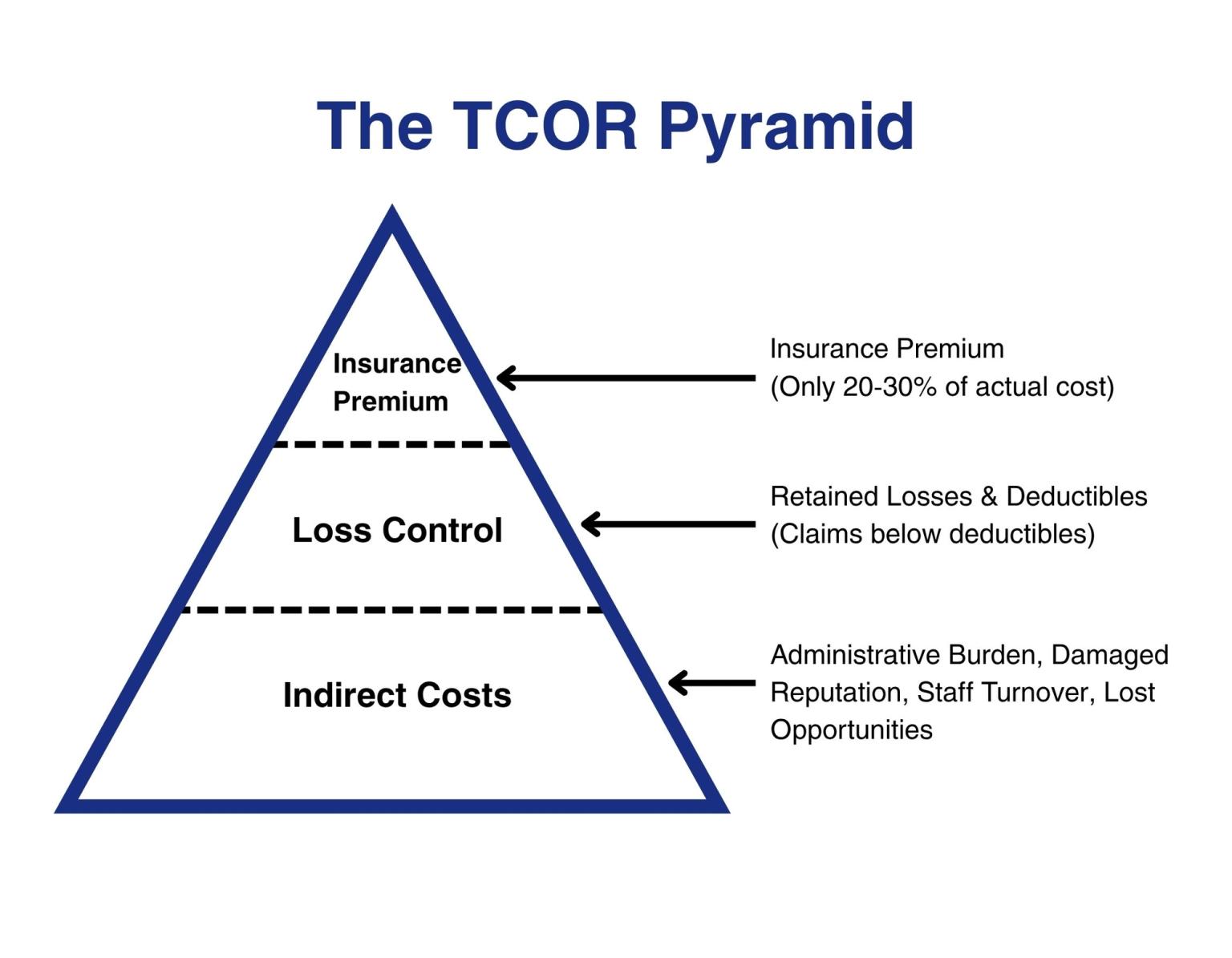
However, the annual insurance premium is merely the visible apex of your risk expenditure. TCOR is a comprehensive metric that calculates the entire financial impact of operational exposure on your organization. It includes:
- Insurance Premiums: The direct cost paid to the carrier.
- Retained Losses: Out-of-pocket capital expended for deductibles or, more critically, completely excluded liabilities resulting from restrictive policy language.
- Risk Control Investments: The cost of credentialed staff training, background screening protocols, and internal compliance management.
- Indirect Costs: The invisible financial drain following an incident, including reputational erosion, lost municipal contracts, and the hundreds of executive hours spent in litigation instead of programmatic execution.
The Math: A policy with a $50,000 premium and highly restrictive coverage can easily result in a TCOR of $500,000 after a single major uninsured claim. Conversely, a $65,000 premium paired with robust, meticulously engineered coverage might yield a TCOR of just $75,000 over the same period.
The Underwriting Traps: 4 Restrictive Endorsements to Avoid
To offer artificially low upfront premiums, specialty carriers radically limit their risk exposure by embedding highly restrictive endorsements into the policy. In human services, these exclusions represent catastrophic blind spots:
1. The Abuse & Molestation Sub-limit
Given your mission, sexual abuse and molestation represent your most catastrophic liability exposure. A structurally sound policy maintains SAM limits matching your general liability structure.
- The Trap: Low-cost policies frequently sub-limit SAM coverage to a negligible $100,000, or exclude it entirely unless incredibly rigid, structurally impossible background screening parameters are met continuously. A single claim can generate seven-figure defense costs, completely bankrupting an underinsured agency.
2. Designated Premises Limitations
Forward-thinking human services agencies operate dynamic programs that require off-site community integration, in-home care visits, or mobile street outreach.
- The Trap: Discounted policies routinely include a “Designated Premises Only” endorsement. If an incident occurs during a community outreach program, a local park outing, or a home visit, your carrier will formally repudiate all defense and indemnity because it did not happen at the exact physical street address listed on the policy.
3. Assault & Battery Exclusions
When caring for populations navigating behavioral health challenges or high-crisis situations, physical de-escalation is an inherent operational reality.
- The Trap: Lower-tier general liability policies frequently contain absolute “Assault & Battery” exclusions. If a client injures another resident or a staff member, and a subsequent lawsuit alleges negligent supervision, the carrier is contractually excused from defending your agency.
4. The Hired & Non-Owned Auto Passenger Exclusion
Most community agencies rely heavily on volunteers or employees utilizing their personal vehicles to transport clients to appointments or travel between service locations.
- The Trap: Standard, low-cost HNOA policies often quietly exclude the transport of passengers entirely. If a volunteer is involved in an auto accident with a client in the passenger seat, your organization’s vicarious liability is left completely exposed to the open market.
The Financial Proof: A Comparative Study
To understand the operational impact of the “Blind-Buy,” let us examine two identical developmental disability service providers facing the same incident: an agitated client injures a member of the general public during a community outing, resulting in a $300,000 lawsuit alleging negligent supervision.
- Agency A: Purchased the cheapest quote ($80,000 premium). The policy contained a Designated Premises Only endorsement and an Assault & Battery exclusion. The carrier denies the claim entirely. Agency A is forced to liquidate $50,000 from operating capital to fund defense counsel and settles for $250,000 directly from its reserves.
- Agency A’s TCOR: $80,000 (Premium) + $300,000 (Retained Loss) + $20,000 (Indirect disruption) = $400,000
- Agency B: Purchased structurally sound coverage ($105,000 premium) with full off-premises and A&B protection. The carrier immediately accepts the claim, assigns specialized defense counsel, and covers the settlement in full.
- Agency B’s TCOR: $105,000 (Premium) + $5,000 (Deductible) + $5,000 (Indirect disruption) = $115,000
By seeking an upfront premium savings of $25,000, Agency A absorbed an additional $285,000 in unbudgeted losses a catastrophic event that would force many agencies to shut down critical programs.
Taking Control: The Renewal Control Blueprint
For the internal coordinator tasked with managing the insurance program, the fear of walking into a board meeting to explain an uninsured $300,000 claim is paralyzing. You should not have to become an insurance actuary to protect your organization’s balance sheet or your own career.
At Metropolitan Risk, we act as your outsourced risk management department. We replace the traditional, reactive quoting circus with our proprietary Renewal Control Blueprint:
- Build the Coverage Blueprint: We do not wait for quotes to see what the market offers. We define exactly what “good” looks like upfront, aggressively auditing your current policies to strip out lethal SAM, A&B, and Designated Premises exclusions before we ever approach the market.
- Quote-to-Blueprint Scoring: We eliminate trust-based purchasing. When carrier options return, we do not compare them on top-line premium alone. We score every option against the agreed-upon Blueprint, mathematically evaluating your true TCOR so decisions are based on structural defense.
- Decision-Ready CEO Updates: We do the heavy analytical lifting. We translate complex actuarial output and restrictive endorsements into clean, simple choices. You gain the exact financial rationale you need to confidently present a bulletproof strategy to your Board of Directors, completely removing your social and professional risk.
Your donors, your staff, and the clients who rely on your care depend on your institutional stability. Evaluating commercial insurance strictly on upfront pricing is a high-stakes gamble you cannot afford to lose.
Contact Metropolitan Risk today to schedule a comprehensive diagnostic audit. Stop paying the blind invoice, and start financing your risk with total control.
Disclaimer: This article is for informational purposes only and does not constitute legal or binding insurance advice. Coverage determinations are subject to the specific terms, conditions, and exclusions of your individual policy. Always consult with a licensed risk advisor regarding your specific exposures.