For human services organizations, the most severe threat to operational survival rarely stems from a sudden regulatory shift or a public funding contraction. Instead, it is frequently hidden inside a highly restrictive endorsement within a commodity-priced commercial insurance policy.
Every year, executive directors, CFOs, and board members of non-profits, community health clinics, developmental disability services, and behavioral health networks select the lowest upfront insurance premiums to preserve tight operational budgets. They operate under the false premise that a lower rate simply represents a shrewder purchase.
The structural reality of commercial risk placement is far more punishing: discounted premiums are almost always engineered by stripping away essential coverage through restrictive endorsements.
When a severe claim occurs—whether a complex allegation of abuse, a catastrophic passenger transport accident, or a physical injury during community outreach—the carrier formalizes a swift coverage denial. This leaves the organization to absorb six-figure legal defense fees and settlements entirely out of operating capital. For leadership, this represents not just a budgetary crisis, but a profound breach of fiduciary stewardship.
To safeguard your organization’s mission, protect your clinical staff, and secure the vulnerable populations you serve, executive leadership must look past the upfront premium and master a critical financial metric: The Total Cost of Risk (TCOR).
Human services providers operate within one of the most volatile economic frameworks in the country. Heavily reliant on fixed government contracts, reimbursement rates, and private donations, your organization faces persistent challenges:
When every dollar allocated to administrative overhead is a dollar diverted from direct client programming, the temptation to view commercial insurance as a transactional commodity is highly understandable. When presented with competitive marketing quotes, the natural, budget-conscious default is to select the lowest upfront price.
However, commercial insurance is not a standard business commodity. When you purchase a discounted policy, you are not securing identical protection at a lower cost. You are investing in a structurally compromised, highly restrictive contract that shifts the ultimate liability back onto your organization’s balance sheet.
To break free from the premium-focused purchasing cycle, leadership teams must transition from an “upfront acquisition cost” mindset to a Total Cost of Risk (TCOR) analysis.
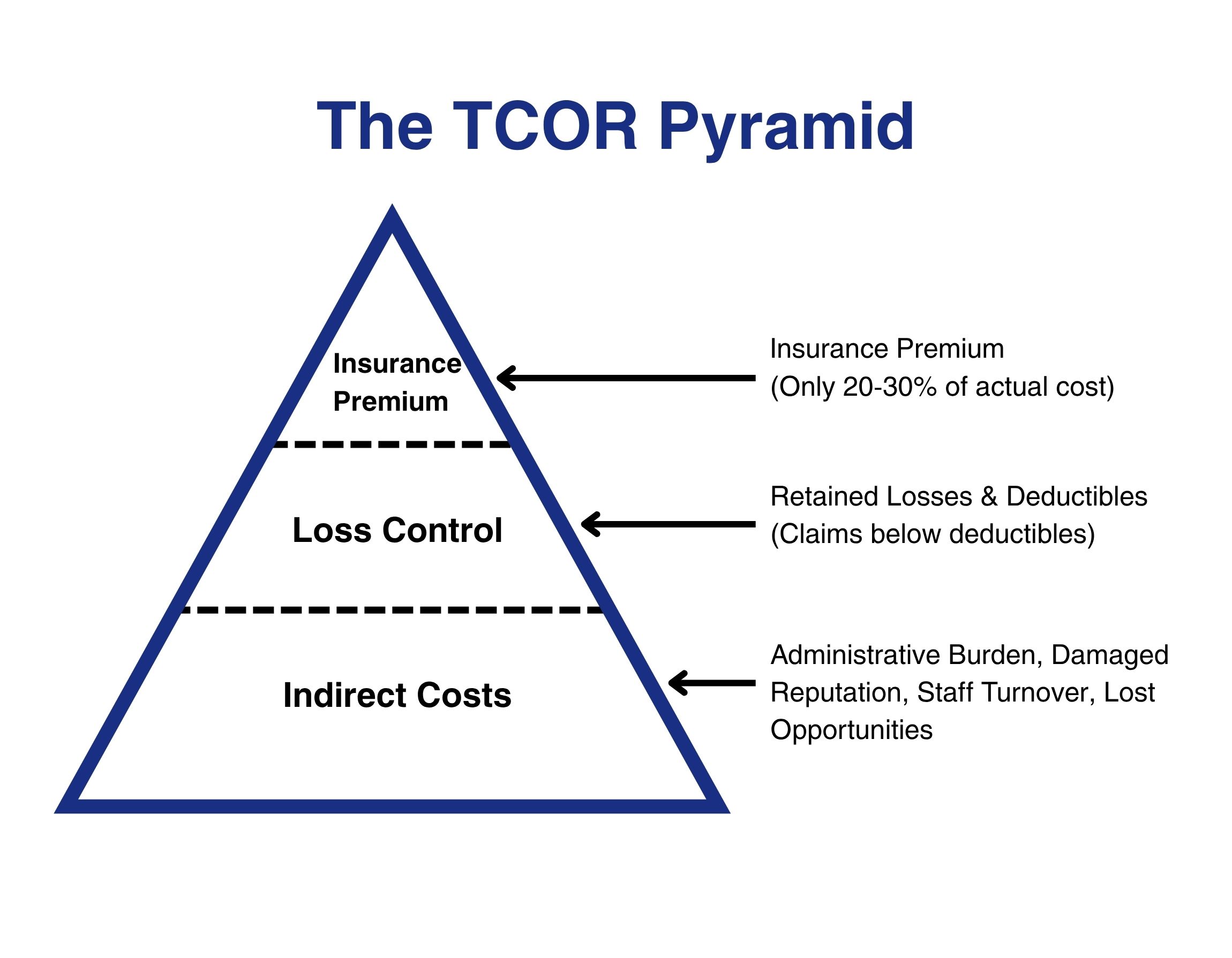
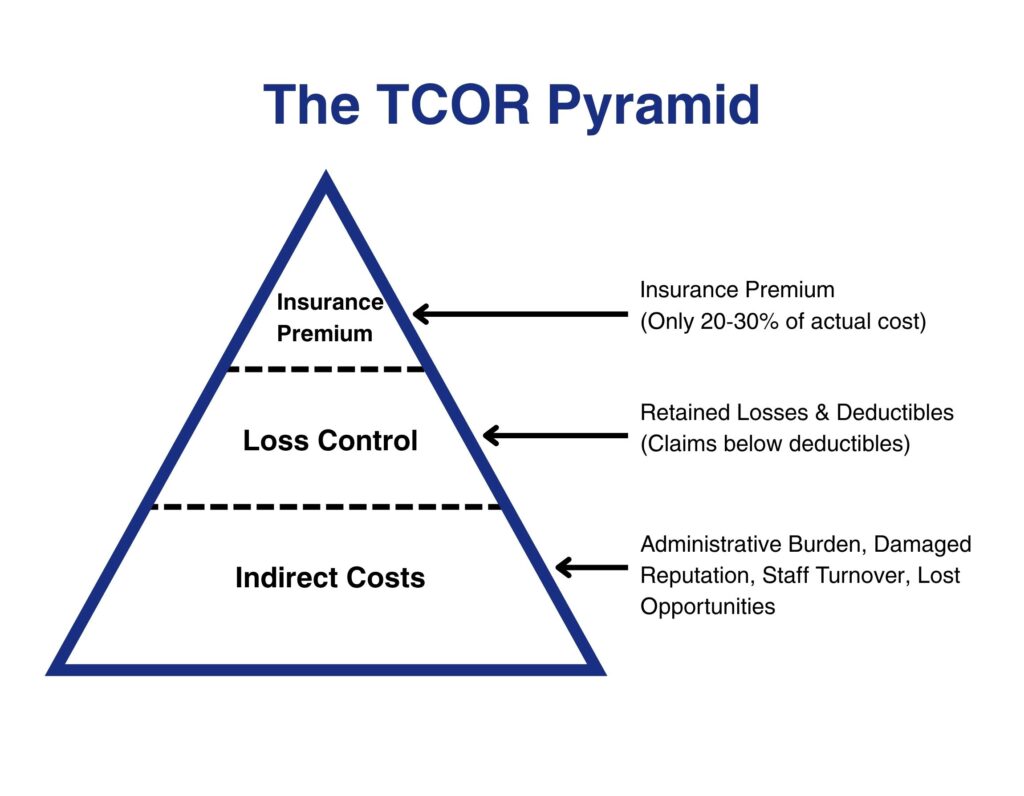
The annual insurance premium is merely the visible apex of your risk expenditure. TCOR is a comprehensive metric that calculates the entire financial impact of operational exposure on your organization. It is calculated through four main components:
TCOR = Insurance Premiums + Retained Losses + Risk Control/Administration + Indirect Costs
The direct, transfer pricing paid to the underwriting carrier in exchange for contractually absorbing defined risks.
The out-of-pocket capital expended for claims below your deductible limits, within self-insured retentions, or—most critically—completely excluded liabilities resulting from restrictive policy language.
The operational investments required to prevent losses, including credentialed staff training, background screening protocols, fleet telematics, physical security systems, and the internal labor hours dedicated to compliance, safety, and claims coordination.
The invisible, non-transferable financial drain on an organization following an incident. In human services, these often surpass the direct cost of the claim:
The TCOR Reality: A policy with a $50,000 premium and highly restrictive coverage can easily result in a TCOR of $500,000 after a single major uninsured claim. Conversely, a $65,000 premium paired with robust coverage and proactive risk control might yield a TCOR of just $75,000 over the same period.
To offer artificially low upfront premiums, specialty surplus lines carriers must radically limit their risk exposure. They achieve this by embedding highly restrictive endorsements into the policy text. In human services, these exclusions represent catastrophic vulnerabilities:
Given your mission, sexual abuse and molestation represents your most catastrophic liability exposure. A premium-grade policy maintains SAM limits matching your general liability structure ($1 million per occurrence / $3 million aggregate).
Many forward-thinking human services agencies operate dynamic programs that require off-site community integration, in-home care visits, or mobile street outreach.
When caring for populations navigating behavioral health challenges, developmental differences, or high-crisis situations, physical de-escalation is an inherent operational reality.
Most community agencies rely heavily on volunteers or employees utilizing their personal vehicles to transport clients to medical appointments, run essential errands, or travel between service locations.
To understand the operational impact of purchasing on upfront premium price alone, let us examine two identical developmental disability service providers: Agency A and Agency B.
| Risk Management Element | Agency A (The Premium Buyer) | Agency B (The TCOR Strategist) |
|---|---|---|
| Annual Premium | $80,000 (Choose the cheapest quote) | $105,000 (Choose comprehensive coverage) |
| Policy Features | Sub-limited Abuse coverage; Designated Premises only; Assault & Battery excluded. | Full Abuse coverage; Worldwide/Off-premises coverage; Active Risk Management Support. |
| Proactive Risk Control | None. (No budget left, no carrier support). | Implemented vetted driver training and client de-escalation protocols. |
During an organized community integration outing, an agitated client injures a member of the general public. The family of the injured individual files a third-party lawsuit against the agency for $300,000, alleging negligent supervision, lack of training, and structural organizational failure.
Agency A’s TCOR: $80,000 (Premium) + $300,000 (Retained Loss) + $20,000 (Indirect disruption) = $400,000
Agency B’s TCOR: $105,000 (Premium) + $5,000 (Deductible) + $5,000 (Indirect disruption) = $115,000
By seeking an upfront premium savings of $25,000, Agency A absorbed an additional $285,000 in total cost of risk—a catastrophic operational loss that would force many human services agencies to shut down critical programs or execute immediate layoffs.
Your donors, your staff, and the clients who rely on your care depend on your organization’s institutional stability. Evaluating commercial insurance strictly on upfront pricing is a high-stakes gamble where the ultimate loss is your agency’s very survival.
By shifting your administrative focus to the Total Cost of Risk, conducting thorough contract audits to eliminate restrictive endorsements, and actively managing operational exposures, you ensure your precious capital remains where it belongs: funding your mission and protecting your community.
Is your current insurance program secretly exposing your agency’s balance sheet to uninsured liabilities? Contact the Risk Strategists at MetRisk Services today for a comprehensive, complimentary TCOR analysis and policy audit. Let us ensure your safety net is structurally sound.